You can usually tell what a floor coating will do long-term by what the space does daily. A garage that sees hot tires, oil drips, and weekend projects needs a different system than a shop floor with constant foot traffic, or a warehouse aisle that gets pallet jacks all day. That is why the “best” coating is rarely universal.
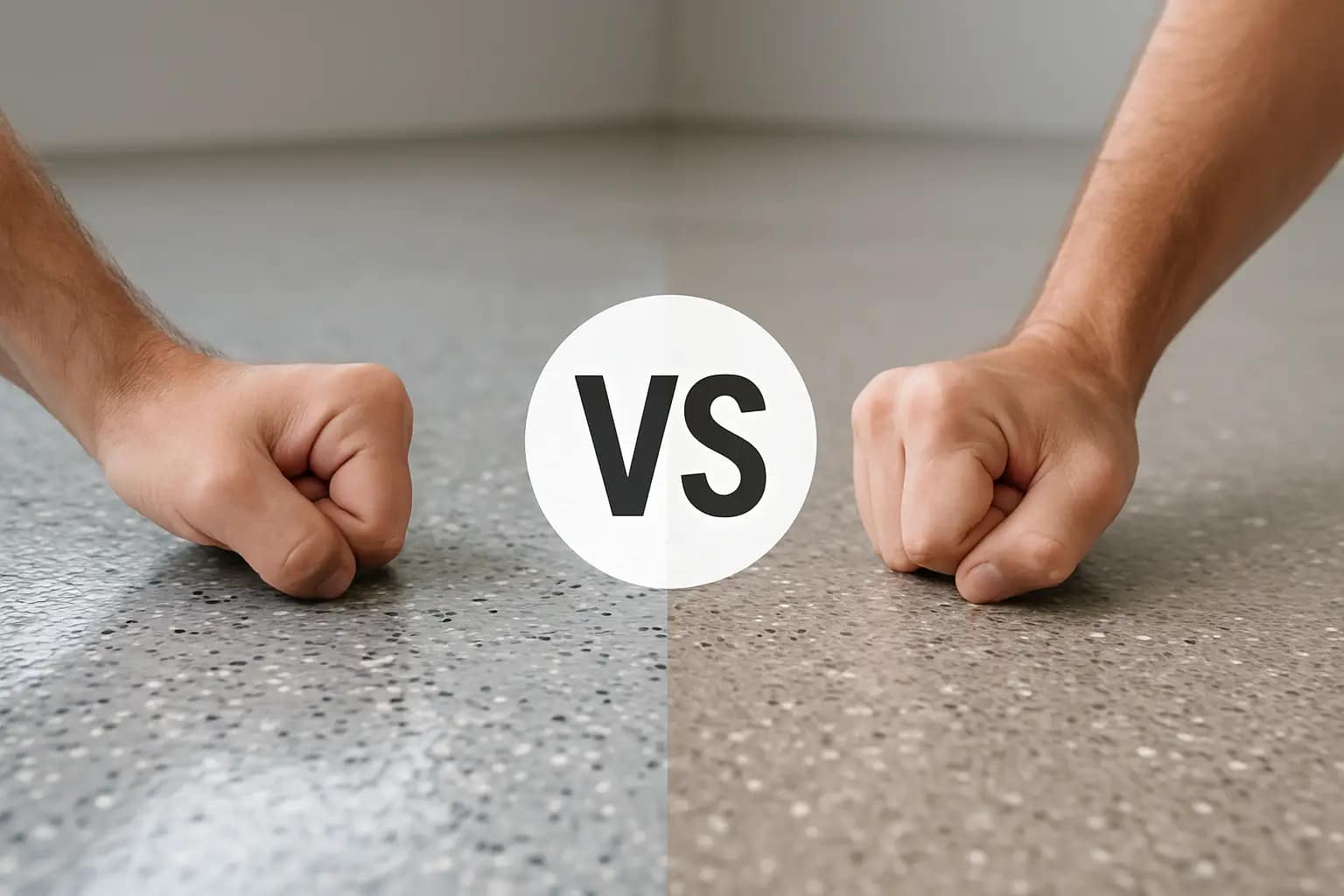
If you are weighing epoxy floor coating vs polyaspartic, the right choice comes down to how fast you need the floor back, how much sun hits it, what kind of wear it will see, and how much risk you can tolerate from shortcuts in preparation. Both systems can perform at a high level when installed properly. Both can fail early when concrete prep is rushed.
Epoxy floor coating vs polyaspartic: the real difference
Epoxy is a proven, heavy-duty resin system that bonds well to properly prepared concrete and builds a tough film thickness. It is widely used in garages, warehouses, plant rooms, commercial kitchens, and workshops because it handles abrasion and chemical exposure well and offers a clean, easy-to-maintain surface.
Polyaspartic is part of the polyurea family. In practical terms, it is known for faster curing, strong wear resistance, and better UV stability than many traditional epoxies. It is often selected when downtime needs to be minimal or when the floor is exposed to sunlight that can yellow or chalk some coatings over time.
The catch is that polyaspartic’s strengths can also make it less forgiving. Faster cure times reduce your working window, so mixing, application, and environmental conditions matter. On-site experience matters more than the label on the bucket.
Cure time and downtime: when “fast” matters
If you need the space back quickly, polyaspartic usually wins. Many polyaspartic systems can return to light foot traffic within hours and vehicle traffic within a day, depending on the product and site conditions.
Epoxy generally cures slower. That is not a flaw – it can be a benefit for leveling, working time, and building a thicker, even coat. But it often means a longer wait before you can park a car, move stock back in, or resume normal operations. For some households and businesses, that extra downtime is the main deal-breaker.
If you are planning around tenants, trading hours, or limited access to a garage, cure time is not a minor detail. It is often the first question we ask because it influences the entire specification.
UV exposure and yellowing: garages are not all the same
A common misconception is that “garages are indoors, so UV does not matter.” In reality, plenty of garages get strong sunlight at the door line and near windows, and many workshops have roller doors open for long periods.
Many epoxies can amber or chalk with UV exposure. That does not always reduce performance immediately, but it can affect the appearance, especially on lighter colors.
Polyaspartic is typically more UV stable, so it tends to hold its color and gloss better in sun-exposed areas. If your priority is a finish that stays visually clean at the entry and along sunlit edges, polyaspartic is often the safer pick.
A practical middle ground some projects use is epoxy as the build coat with a UV-stable topcoat. The right approach depends on how much sun you actually get and how particular you are about long-term color stability.
Durability under traffic: abrasion, impact, and hot tires
Both systems can be engineered to take real punishment, but they behave a little differently.
Epoxy is known for a hard, dense finish with strong adhesion when the concrete is prepped correctly. It performs well under rolling loads, resists many automotive fluids, and can be built up for extra thickness. For garages and warehouses, that thickness and hardness can translate to a long wearing surface.
Polyaspartic coatings are often valued for their abrasion resistance and toughness, with a bit more flexibility than some epoxies. That flexibility can help in environments where minor movement or impact happens, but it is not a license to ignore cracks, moisture, or weak concrete.
Hot tire pickup is the fear most homeowners mention. Modern professional epoxy systems can resist hot tire pickup well when installed correctly and fully cured. Polyaspartic also performs strongly here, especially when the system is designed for vehicle exposure.
The bigger determinant is not the name – it is the system design and installation quality.
Slip resistance and safety: glossy does not have to mean slippery
A high-gloss floor looks clean, but safety is the real priority in busy garages, commercial kitchens, loading areas, and retail back-of-house spaces.
Both epoxy and polyaspartic can be finished with non-slip textures. The “right” level is site-specific. Too smooth and it can be risky when wet. Too aggressive and it becomes hard to mop and uncomfortable underfoot.
If you are coating a commercial environment, the conversation should include where water, oils, or dust will be present and how the floor will be cleaned. A smart installer will recommend a texture that hits the balance between grip and maintainability, instead of defaulting to maximum grit.
Chemical resistance and staining: what hits the floor
In garages and workshops, chemicals are usually the issue: brake fluid, fuel, degreasers, oils, and battery acids. In commercial settings, it may be cleaning chemicals, food acids, or industrial solvents.
Epoxy is generally strong across a wide range of common exposures, which is why it is used so widely. Polyaspartic can also deliver excellent chemical resistance, but performance depends heavily on the formulation and the topcoat you choose.
If you know exactly what will be spilled, it is worth specifying the system around that reality. A floor that looks great but softens under the wrong chemical is not a value upgrade – it is an avoidable maintenance problem.
Surface prep: the part most people never see (and the part that decides the outcome)
If there is one point that matters more than “epoxy vs polyaspartic,” it is concrete preparation.
Coatings do not bond to dust, curing compounds, laitance, old paint, or contaminated concrete. They bond to clean, mechanically profiled concrete. That is why professional installers grind the surface and control the dust. It is also why crack repairs and skim-coat repairs are not optional add-ons when the slab needs them.
When prep is done properly, both epoxy and polyaspartic can deliver a long-wearing finish. When prep is rushed, you see the same failure patterns: peeling at the tires, lifting at edges, bubbles from moisture, or delamination where the concrete was never properly opened up.
If you are comparing quotes, ask what preparation is included, how cracks will be treated, and whether the team is set up for dust-controlled grinding. Prep is where “cheap” turns into “twice.”
Appearance: flakes, solids, and how “clean” the floor stays
Both systems can produce a sharp, professional look, from solid colors to decorative flake finishes. The difference is less about what is possible and more about what will stay looking good with your kind of use.
Flake systems are popular because they hide dirt and minor marks better than a single solid color. They can also improve slip resistance when paired with the right topcoat texture. Solid colors can look incredibly clean, but they show scuffs, dust, and chips more readily.
If the space is a working garage or a stockroom that will never be spotless, choose a finish that forgives real life. You will enjoy it more.
Cost and value: what you are actually paying for
Pricing varies based on slab condition, square footage, access, moisture risk, and the system build. In general, polyaspartic systems tend to cost more than straightforward epoxy systems, largely due to material cost and the installation demands of faster-curing products.
That does not automatically make epoxy the “budget” choice or polyaspartic the “premium” choice. The value comes from matching the coating to the job and doing the unglamorous work properly: grinding, repairs, moisture management, and a system thickness that matches the wear.
For a homeowner, the value question is often: will it stay easy to clean and keep looking good for years without babying it? For a commercial operator, the value question is usually about downtime, safety, and predictable performance.
Which should you choose for your space?
If you want a proven, heavy-duty finish and you can allow more cure time, epoxy is often the right fit for garages, workshops, warehouses, and many commercial interiors. It is a strong choice when you want thickness, durability, and a system that has decades of real-world track record.
If you need the floor back fast, or you have meaningful UV exposure where yellowing would bother you, polyaspartic often makes sense. It can be especially attractive for active households that cannot leave a garage empty for long, or for businesses that need to reduce downtime.
There are also plenty of cases where a hybrid approach is the best answer. A well-built epoxy base with a UV-stable topcoat can deliver a tough build and improved color stability. What matters is that the system is specified for the environment, not sold as a one-size-fits-all package.
If you want a clear recommendation based on your slab, your traffic, and your timeline, Floor Masters can quote the job end-to-end – including dust-controlled grinding, repairs, and the right coating system for the space. You can start here: https://Floormasters.com.au
A helpful way to think about it is simple: pick the coating that fits how you will actually use the space, then invest in the preparation that makes it last. Your floor does not need hype. It needs workmanship you can rely on.