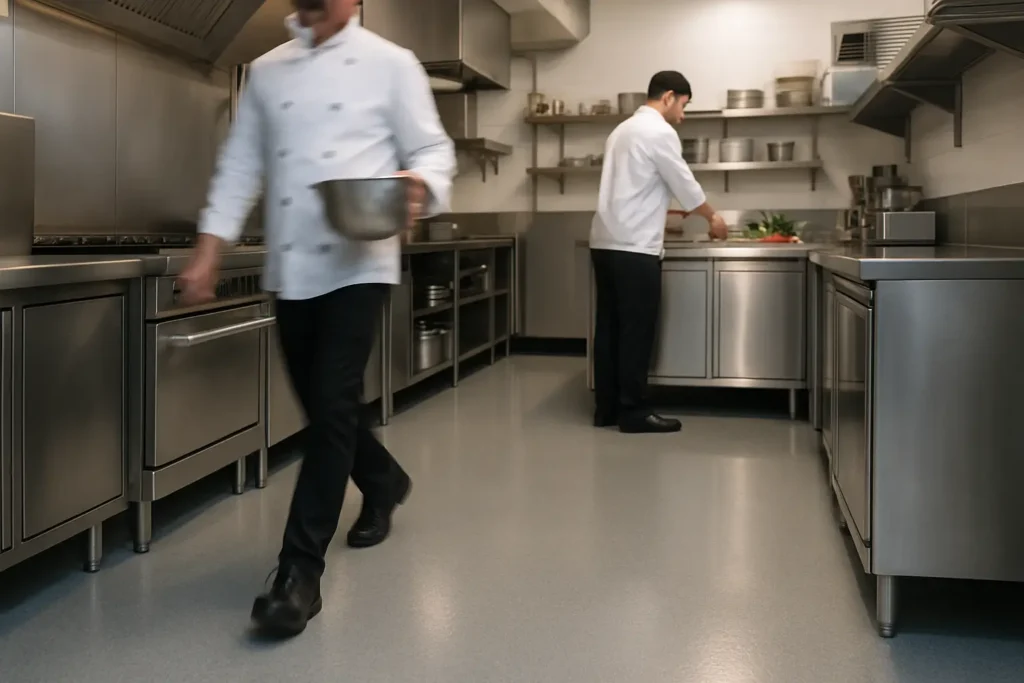
A commercial kitchen floor gets judged fast – usually right after the first spill. Oil hits the ground, a prep cook pivots with a full tray, the dish pit floods, and suddenly the floor is either helping your team move safely or becoming a daily liability.
That is the real reason epoxy flooring for commercial kitchens keeps coming up in fit-outs and refurbishments. You are not just choosing a “nice finish.” You are choosing how your kitchen handles grease, water, heat, cleaning chemicals, and constant foot traffic – without turning into a maintenance headache.
Why epoxy belongs in commercial kitchens
Kitchen floors fail in predictable ways. Grout lines trap grime. Porous concrete absorbs oils and starts to stink. Vinyl seams lift. Tiles get slick when there is a film of fat and detergent. The right epoxy system tackles those failure points by creating a continuous, non-porous surface that is easier to sanitize and far less likely to break down under daily washdowns.
The practical win is cleanliness. A properly installed epoxy system leaves you with a surface that does not absorb liquids and is not full of joints for bacteria and food debris to live in. When you are cleaning to a standard – not just “looks OK” – that matters.
The other win is safety. Kitchens are wet by nature, and water is not the only problem. Cooking oils, animal fats, sugary liquids, and soaps can change the coefficient of friction dramatically. Epoxy can be built with a non-slip profile that fits the area: more grip where it gets soaked (dishwashing, prep sinks) and a smoother texture where you need easier movement (service line), while still keeping it cleanable.
Durability rounds it out. Epoxy is used in warehouses for a reason. In a kitchen, you want that same wear resistance against foot traffic, trolley wheels, and the occasional dropped pot – without the floor turning into a patchwork of repairs.
Where epoxy is a great fit – and where it depends
Epoxy performs extremely well in most commercial kitchen zones, especially dry storage, prep areas, cool rooms (with the correct system), and service corridors. It also suits kitchens that want a brighter, “visually clean” look because it reflects light and makes the space feel more sanitary.
It depends when heat and thermal shock are regular events. If staff are tipping near-boiling water onto the floor, if steam cleaning is frequent, or if there is repeated hot-to-cold cycling, a standard epoxy may not be the best call on its own. In those situations, a heavy-duty screed or a system designed for thermal cycling may be more appropriate, or epoxy may be used in adjacent zones while a different resin system is used at the hot spots. The right answer comes down to how the kitchen actually operates, not what looks good on a spec sheet.
Understanding the main epoxy system options
When people say “epoxy flooring,” they often mean different builds. In commercial kitchens, the system matters as much as the material.
A thin-film epoxy coating is the lightest option. It can improve cleanability and appearance, but it is not designed to mask substrate problems or handle aggressive conditions. If the slab has moisture issues, cracking, or heavy wear, thin coatings can fail early.
A high-build epoxy is thicker and more forgiving, with better wear resistance. This is a common choice for commercial spaces that need durability and easier cleaning without going to a full screed.
An epoxy mortar or trowel-applied build is where you start solving bigger problems: uneven slabs, damaged concrete, and areas that need impact resistance. It costs more, but it can be the difference between a floor that lasts and a floor that becomes a recurring repair line item.
Finally, topcoats matter. A chemical-resistant topcoat can help in areas exposed to degreasers and sanitizers. In some kitchens, a UV-stable topcoat is less critical because there is limited sunlight, but a tougher wear layer can still be worthwhile in high-traffic routes.
Slip resistance without creating a “dirt trap”
Non-slip is not one setting. It is a balance between traction and cleanability.
If you go too smooth, you increase slip risk when the floor is wet or oily. If you go too aggressive, the floor becomes harder to mop and can hold onto grime. The best kitchen installs use different textures by zone and make sure coves, drains, and thresholds are detailed properly so cleaning is fast and complete.
In practice, the most successful kitchens treat slip resistance as part of the workflow. Where do spills happen? Where do people turn quickly? Where do staff stand for long periods? Those answers should shape the finish, not a one-size-fits-all texture across the entire slab.
The make-or-break factor: surface preparation
Epoxy fails for one main reason – the surface under it was not prepared correctly.
Commercial kitchen slabs often have contamination you cannot see clearly: old fats, silicone from past repairs, cleaning chemical residues, curing compounds, or moisture vapor coming through the concrete. If those issues are not handled, epoxy can delaminate, bubble, or wear prematurely.
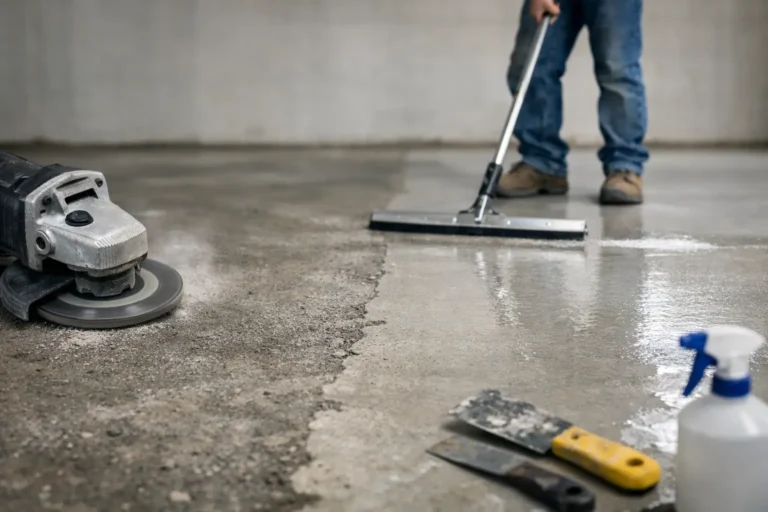
Professional preparation usually means mechanical grinding to open the concrete and create a profile the epoxy can bond to. In working buildings, dust-controlled grinding is not a “nice extra.” It is how you keep adjacent areas cleaner and reduce disruption.
Cracks and spalls also need the right repair approach. Filling a crack is not the same as stabilizing it, and patching a weak area without proper prep can telegraph through the coating later. Good installers treat repairs as part of the system, not a quick cosmetic step.
Drainage, coves, and wall junctions: the details health inspectors notice
Kitchens are cleaned from the top down, and floors take the brunt of that process. If water sits, it will find the weakest point.
Falls to drains should be checked before coating. Epoxy will not magically create slope. If drainage is poor, it is better to address it during the build so water does not pool in corners or along equipment lines.
Coved skirting is another detail that pays off. Bringing the system up the wall at the perimeter eliminates the hard-to-clean joint where floor meets wall. It also reduces the chance of moisture getting under the coating at the edges – a common failure point in wet zones.
Chemical resistance and cleaning routines
Commercial kitchens use strong products: degreasers, sanitizers, and sometimes acidic cleaners. Epoxy has good chemical resistance, but “good” still depends on the exact products, concentrations, dwell time, and how often the floor is rinsed.
If your team regularly uses aggressive chemicals, that should be part of the specification. A better topcoat or a different resin build may save you from premature dulling, softening, or staining.
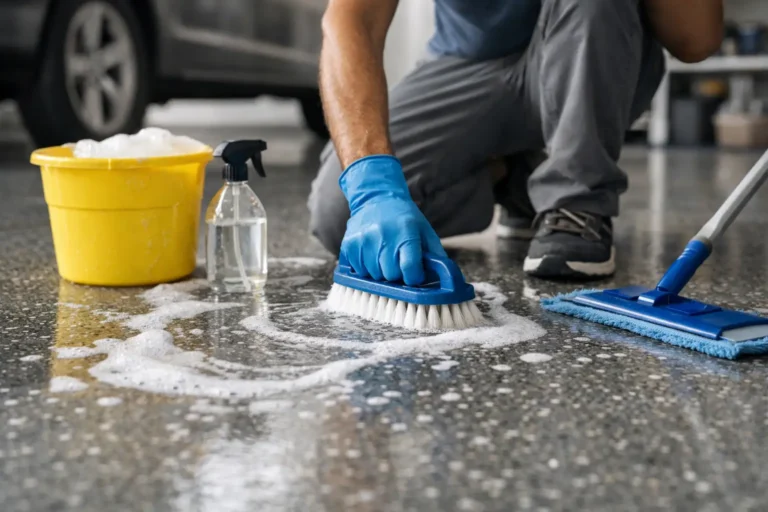
On the maintenance side, epoxy is straightforward: sweep grit off daily (it acts like sandpaper under shoes), clean spills quickly, and use the cleaning products recommended for the installed system. The goal is to keep the floor safe and bright without slowly wearing it down with overly harsh methods.
How long does installation take in an operating kitchen?
Time matters because downtime costs money. Most commercial kitchen epoxy installs are planned around shut windows, staged areas, or after-hours work.
The timeline depends on floor condition and system build. Simple recoats move faster than repairs and rebuilds. Moisture mitigation, significant crack repair, or resurfacing to fix falls will add time – but that extra time is often the difference between a floor that lasts years and one that starts peeling months later.
Cure times also matter. Epoxy is not “ready” just because it looks dry. You need the correct cure before heavy traffic, equipment loads, and hot washdowns. A contractor should set expectations clearly so you can plan reopening without risking early damage.
What affects the cost of epoxy flooring for commercial kitchens?
If you are comparing quotes, look at what is actually included. The biggest cost drivers are the condition of the existing slab and the level of preparation needed, the thickness and type of system specified, the amount of repair work, and the slip-resistance finish chosen.
Access and staging can also change the number. A clear, empty room is faster than a live site with fixed equipment, tight hours, and multiple trades working around each other. The right quote is not the cheapest line item – it is the one that matches your kitchen’s risk profile and workload.
Choosing a contractor: what to ask
A kitchen floor is not the place for vague promises. Ask what mechanical preparation method will be used, how cracks and damaged areas will be repaired, and what system build is being specified – including slip rating approach and topcoat.
You also want clarity on how the site will be kept clean during prep, how curing will be managed, and how edges, drains, and coves will be detailed. If the answers sound generic, expect generic results.
If you are in Sydney or across NSW and want a quote that covers surface prep through to the finished system, Floor Masters handles epoxy installations along with concrete grinding and repairs so the coating is built on the right foundation. You can start with a fast, transparent quote at https://Floormasters.com.au.
A helpful closing thought
The best commercial kitchen floors are the ones your team stops thinking about. When the surface is prepped correctly, textured appropriately, and detailed around drains and walls, epoxy becomes less of a “flooring choice” and more of an operational upgrade that quietly reduces slips, cleanup time, and repair surprises.