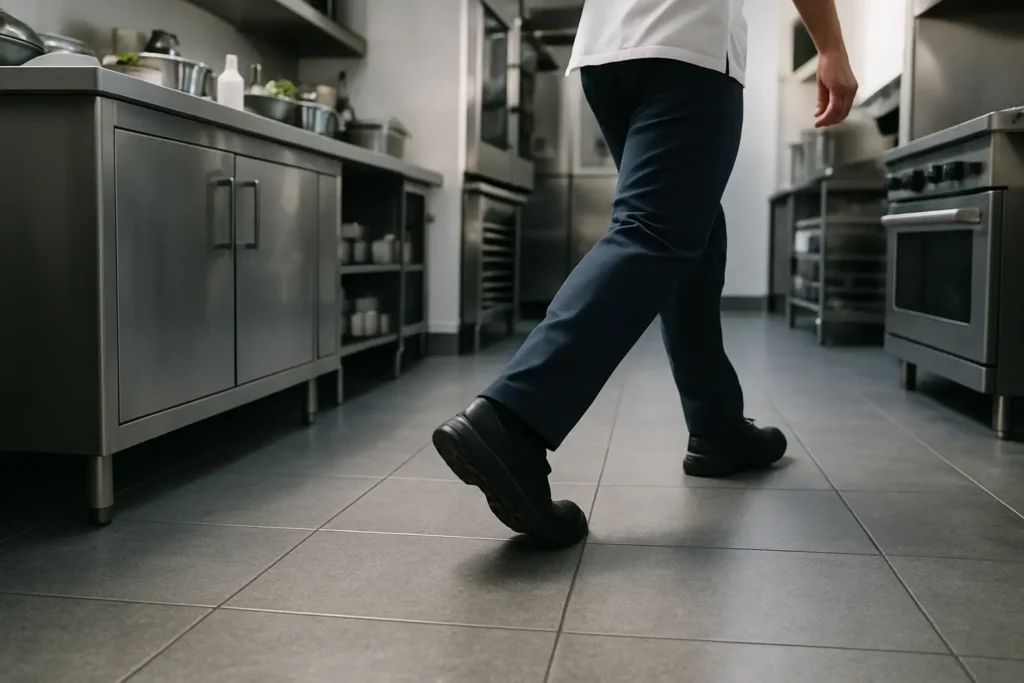
A commercial kitchen can look spotless and still be one step away from a fall. It only takes a thin film of oil near the fryer, a wet patch at the dish station, or a rushed service changeover for a “fine” floor to become a liability.
When you’re selecting slip-resistant commercial kitchen flooring, you’re not just picking a finish that’s easy to mop. You’re choosing how your team moves, how confidently they can work under pressure, and how well your site holds up when moisture, grease, heat, and harsh cleaning chemicals hit every day.
Slip-resistant commercial kitchen flooring: meeting Australian standards (AS 4586)
If you’ve heard people talk about “R ratings,” they’re usually referring to the oil-wet ramp test classification under AS 4586 (the slip resistance standard used in Australia). In plain terms, AS 4586 is about measuring slip resistance in repeatable conditions, then classifying the result.
In a kitchen context, the detail that matters is this: the rating needs to match the way the floor is actually used. A dry pantry area is not the same risk environment as a wet washdown zone, and a prep line is not the same as the dish pit.
AS 4586 classifications are commonly expressed as an R rating (R9 through to R13). The higher the number, the greater the slip resistance in the test conditions. That doesn’t automatically mean “higher is always better” in every part of a kitchen – because slip resistance often comes with texture, and texture affects cleanability.
The goal is to specify slip resistance that’s fit for purpose, then install it on a properly prepared substrate so the performance you paid for is the performance you actually get.
What causes slips in commercial kitchens (and why “non-slip” is not one-size-fits-all)
Most kitchen slip events are a combination problem: contamination plus movement plus surface conditions. Water reduces friction. Oil reduces it further. Food waste creates unpredictable slip points. And the way staff move – quick turns, carrying loads, stepping from dry to wet zones – amplifies the risk.
That’s why a smooth, glossy floor that looks great in a showroom can be a poor performer in a working kitchen, especially once it gets a layer of detergent residue or fine grease that isn’t fully broken down.
But the opposite extreme has its own trade-off. Very aggressive texture can help traction, yet it can also trap grime, making cleaning slower and less effective. In a high-pressure kitchen, if the floor is “too hard to clean properly,” it won’t stay clean – and slip risk can creep back in.
The right answer is usually zoned thinking: higher slip resistance where it’s routinely wet or greasy, and a more balanced finish where you still need grip but cleaning speed matters.
Choosing the right slip rating for kitchen zones
Many operators want a single rating across the whole kitchen for simplicity. Sometimes that’s workable, but it’s not always the safest or the most practical.
A smarter approach is to map your risk areas. The dishwashing and washdown zones often demand the highest traction because they stay wet and get hit with overspray and detergents. Cook lines can see frequent oil contamination, especially near fryers, flat tops, and hot wells. Cold rooms and storage areas can be lower risk, but they still see moisture and traffic.
What rating should you choose? It depends on how your kitchen runs, how often you wash down, what contaminants are common, and what footwear your staff use. The key is to select a surface that has been tested and classified, then match it to the area’s exposure.
If you’re comparing options, don’t rely on a sales claim like “non-slip.” Ask what slip test classification the system achieves, under what conditions, and whether it’s appropriate for oil-wet or wet environments.
Epoxy flooring in commercial kitchens: where it fits (and where it doesn’t)
Epoxy systems are popular in commercial environments for a reason: they’re durable, chemical resistant, and can be detailed into coves and upturns for hygiene. But the word “epoxy” covers a wide range of systems.
A basic smooth epoxy can be hard-wearing and easy to mop, but it may not be suitable for wet, greasy kitchen zones without a slip-resistant broadcast texture. On the other hand, a heavily textured epoxy can improve grip dramatically, yet it must be designed so it can still be cleaned effectively.
There are also heat considerations. Some kitchens have extreme temperature cycling, hot water washdown, or localized heat near cooking equipment. The flooring system needs to handle that environment without softening, cracking, or debonding.
This is where specification matters: the resin type, the thickness, the aggregate used for texture, the topcoat, and the detailing at drains and junctions all change performance.
The part most people underestimate: surface prep
Slip resistance is only useful if the flooring stays bonded and intact. In commercial kitchens, the biggest failures we see are rarely caused by “bad epoxy” in isolation – they come from poor preparation and moisture-related issues.
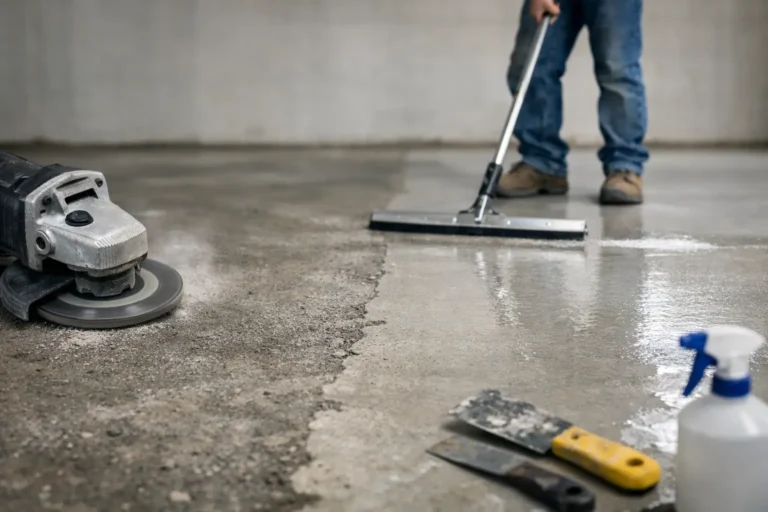
Concrete is not a uniform, clean canvas. It can have contaminants, weak laitance, old coatings, curing compounds, or moisture vapor pressure. If a new system is installed over a poorly prepared slab, you can end up with peeling, bubbling, hollow spots, or premature wear. Once the surface starts breaking down, cleaning gets harder and slip risk rises.
Proper mechanical preparation – typically grinding with the right tooling and dust control – creates the surface profile needed for adhesion. Repairs matter too. If there are cracks, divots, or spalled areas, they should be addressed before coating, not “hidden” under the finish.
In wet areas, drainage details also matter. A floor can be classified as slip-resistant and still be unsafe if it holds puddles. The safest kitchens combine a fit-for-purpose slip texture with a floor that drains properly and stays easy to squeegee.
Texture, cleanability, and real-world hygiene
Kitchen managers often get stuck between two priorities: “We need more grip” and “We need it to clean fast.” The right system respects both.
Texture can be engineered. A broadcast aggregate creates a consistent, controlled grip. The topcoat then locks that texture in so it doesn’t shed and so the surface can be cleaned without the floor feeling like sandpaper.
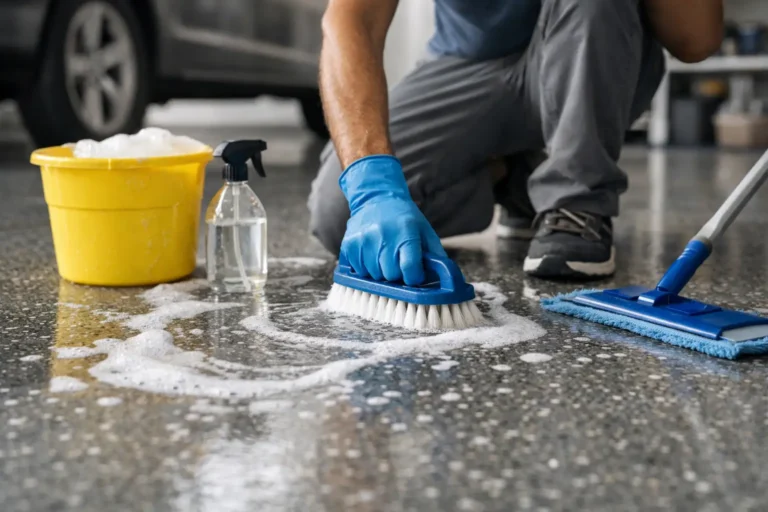
The cleaning routine matters as much as the flooring choice. Degreasers, hot water, and scrubbing methods can leave residues if not rinsed properly. Over time, that residue can reduce traction – even on a textured surface. A good flooring system should tolerate your cleaning chemistry, but it also needs the right maintenance plan so the slip resistance you started with is the slip resistance you keep.
If your kitchen uses aggressive chemicals, or if you do frequent hot washdowns, it’s worth confirming chemical and thermal suitability as part of the flooring specification, not after a problem shows up.
Common mistakes that lead to slippery or short-lived floors
The fastest way to waste money on a kitchen floor is to focus only on the top layer and ignore the conditions underneath or the way the space operates.
One common mistake is choosing a glossy, easy-clean finish in a wet zone and assuming footwear will compensate. Shoes help, but they don’t eliminate risk when the floor is contaminated.
Another is going too aggressive with texture everywhere. That can slow cleaning, encourage grime build-up, and create a different kind of safety issue if staff can’t keep the surface hygienic.
We also see problems when floors are patched and coated without addressing moisture. Moisture vapor can push coatings off concrete over time. If there are signs like dampness, efflorescence, or previous coating failures, moisture testing and the right primer strategy become part of the solution.
Finally, rushed shutdown windows can lead to shortcuts on prep or cure time. In a commercial kitchen, timing matters – but cutting cure time can mean a floor that marks, softens, or fails early.
What to ask your flooring contractor before you commit
A commercial kitchen floor is a performance system, not a paint job. Before you approve a quote, you want clear answers on how the floor will be built and what it’s designed to handle.
Ask what AS 4586 slip classification the proposed system achieves, and whether it’s appropriate for your kitchen’s wet and greasy areas. Ask how the surface will be prepared – specifically, what mechanical method will be used and how dust will be controlled. Ask how cracks and damaged areas will be repaired, and how junctions, drains, and coves will be detailed.
You should also confirm downtime expectations, cure time before foot traffic, and when the area can return to full washdown and heavy use. A contractor who works in live environments should be able to explain staging options that reduce disruption.
If you’re in Sydney or across NSW and want an end-to-end approach that treats slip resistance and surface preparation as part of the same safety outcome, Floor Masters can quote the full scope – from concrete grinding and repairs through to a slip-resistant epoxy system built for commercial conditions (https://Floormasters.com.au).
A practical way to think about “safe” flooring
A safer commercial kitchen floor isn’t the one with the most aggressive texture on paper. It’s the one that matches your wet and greasy zones, stays clean without heroic effort, drains properly, and holds up to daily punishment without peeling or polishing smooth.
If you’re planning a new kitchen fit-out or you’re tired of near-misses on an old, worn surface, treat slip resistance as an operational decision, not a cosmetic one – your team will feel the difference every shift.