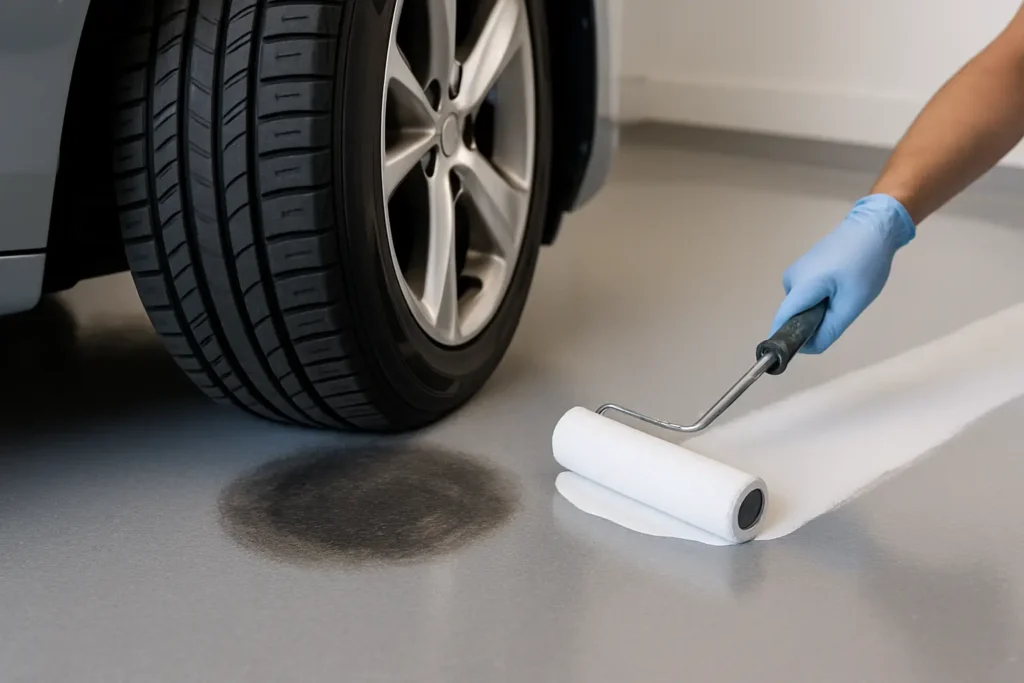
If you’ve ever backed your car out of the garage and seen dark, gummy tire marks – or worse, little patches of coating stuck to the rubber – you’ve run into hot tire pickup. It’s one of the quickest ways a garage epoxy floor can go from “brand new” to “what happened?” in a single weekend.
Hot tire pickup isn’t just about heat. It’s about heat plus softening, plus adhesion, plus timing. And the fix depends on what you have down right now: a DIY kit, a single-coat epoxy, a properly built system, or an epoxy that never fully cured.
What hot tire pickup actually is (and why it happens)
Hot tire pickup happens when warm rubber tires bond to a coating that is still soft enough to grab – then pull at the surface when you turn the wheel or drive away. Sometimes it leaves a stain. Sometimes it lifts the coating. Either way, the root cause is usually the same: the top layer didn’t have enough heat resistance, hardness, or cure before taking traffic.
A tire coming off the road can be surprisingly hot, especially after highway driving. Add the weight of the vehicle, a little steering twist, and the plasticizers in modern tire rubber, and you’ve got a perfect stress test for any coating.
Here’s the nuance most people miss: even a “hard” coating can be vulnerable if it’s thin, under-cured, or sitting on a weakly prepped slab. You don’t just need a tougher topcoat – you need a system that’s built to handle heat, load, and movement.
How to stop hot tire pickup epoxy: start with the right system
If you’re choosing a new floor (or redoing a failed one), the best prevention is specifying the coating stack correctly. In real-world garages, hot tire pickup is far less likely when the floor has a properly prepped substrate, a solid base coat, and a topcoat designed for heat and abrasion.
A common failure pattern is a single-coat epoxy or a thin “paint-like” product. It can look great on day one, but it doesn’t always have the film build or the surface properties to resist hot rubber and twisting tires.
For garages and high-traffic areas, a more dependable approach is an industrial-grade epoxy base for build and adhesion, then a tougher topcoat (often polyurethane or polyaspartic depending on the application) for chemical resistance, UV stability where relevant, and higher scratch and heat performance. The topcoat is what the tire touches, so that choice matters.
It also matters how the installer manages recoat windows. If the topcoat goes on too late without proper sanding, you can end up with weak intercoat bonding. That can look fine at first, then peel when stressed.
Cure time: the most ignored cause of hot tire pickup
If you want to know how to stop hot tire pickup epoxy problems on an existing floor, start by being honest about cure time.
Many epoxies are “dry to touch” quickly but aren’t fully cured for days. Some need a week (or longer) before they reach peak hardness and chemical resistance. Parking on it early is one of the fastest ways to create tire marks, imprints, and bonding.
Temperature and humidity affect cure more than most people expect. A cool, damp stretch can slow curing and leave the coating softer for longer. A hot day can speed surface cure but still leave deeper layers catching up. Either scenario can create a window where the floor looks ready but isn’t.
If the coating is new and you’re seeing early tire marks, the most practical move is often to keep vehicles off longer and avoid turning the steering wheel while stationary. Rolling straight in and out is less aggressive than turning in place.
Surface prep: where most “epoxy failures” actually start
Hot tire pickup sometimes gets blamed on the coating when the real issue is what’s underneath.
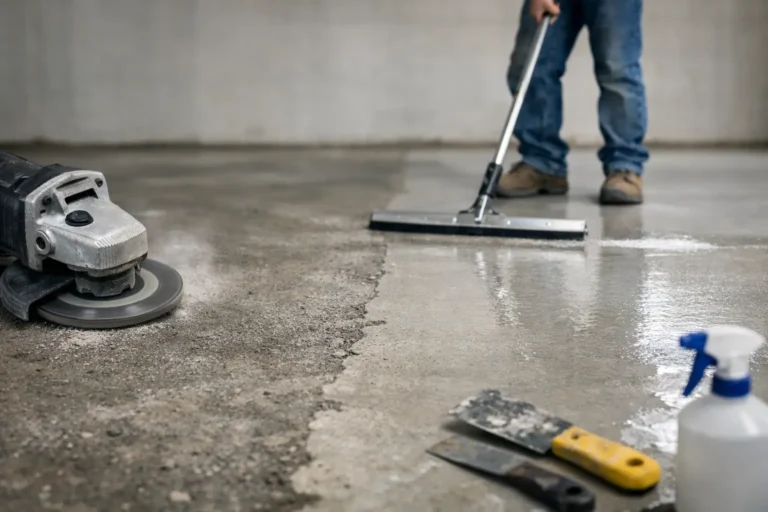
If the concrete wasn’t mechanically ground, coatings can sit on the surface instead of bonding into a properly profiled slab. When a tire grabs, it can pull at a weakly bonded film and lift it. Acid etching alone is a frequent culprit because it doesn’t always open the concrete consistently, and it won’t fix weak laitance, curing compounds, or contamination.
Contamination is another big one in garages. Oil drips, silicone-based products, tire shine overspray, and old sealers can all reduce adhesion. The floor may coat “fine,” but the bond is compromised in the exact spots where tires sit.
If you’re redoing a garage, proper grinding and localized repairs are not optional steps if you want predictable performance. The coating can only be as reliable as the surface it’s stuck to.
Thickness and topcoat selection: thin floors fail first
A coating that is too thin heats up and softens faster. It also has less material to resist abrasion when tires twist.
This is where many kit systems struggle. They often go down thin, with minimal build and a basic clear coat (or none at all). They can still be useful in light-duty spaces, but garages with daily parking, heavier vehicles, or lots of turning are a tougher environment.
A higher-build epoxy base coat can help, but the real improvement usually comes from adding the right topcoat.
Some topcoats are formulated to cure harder and resist rubber marking better. Others are more flexible and can be great for impact resistance but may show marking sooner. This is a trade-off decision, and it should be made based on how the space is actually used: daily commuter parking, weekend-only use, workshops with jack stands, or commercial traffic.
If your garage gets direct sun, UV resistance also matters. Yellowing doesn’t cause hot tire pickup, but it can make the floor look dirty faster and lead to unnecessary scrubbing that wears the surface.
If you already have tire pickup: what you can do now
If the coating is intact but you’re dealing with black marks, you may not need to recoat. Tire marks can be staining, not failure.
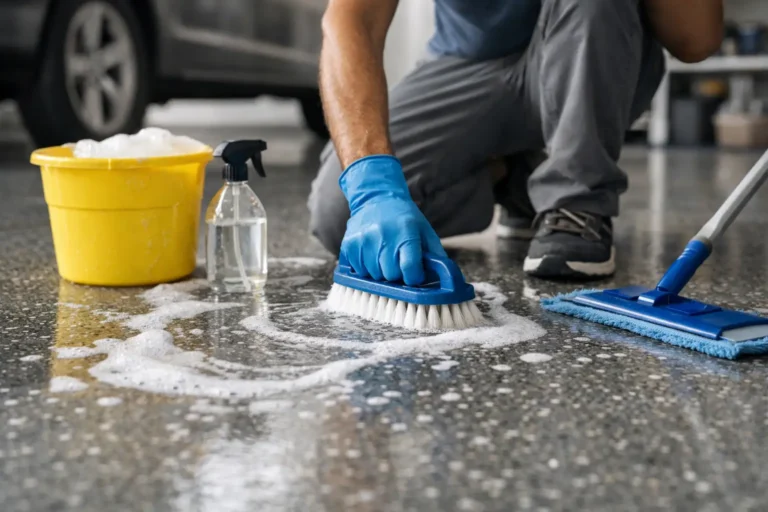
Start gently. A pH-neutral cleaner and a soft bristle brush is safer than harsh solvents. Aggressive chemicals can dull some topcoats or soften a partially cured surface. If you need more bite, step up carefully to a stronger degreaser that’s compatible with coated floors and rinse thoroughly.
If you’re seeing actual lifting or peeling, cleaning won’t solve it. At that point, you’re dealing with adhesion loss or a soft film.
Spot repairs can work when the failure is isolated and the surrounding coating is well bonded. But if the coating peels under one tire, it often means the system is marginal across a larger area – it just hasn’t been stressed everywhere yet.
The most reliable correction is to mechanically abrade or grind back to a sound layer, repair the damaged sections, then recoat with a more appropriate topcoat. Done correctly, this turns a “problem floor” into a floor that behaves like it should under real vehicle use.
Habits that reduce tire marking (even on good floors)
Even with a strong coating system, a couple of usage habits can make a noticeable difference.
If possible, avoid turning the steering wheel while the car is stationary, especially right after a drive. That twisting action is what really grinds rubber into the surface. Rolling a few inches before turning reduces the stress.
Also be cautious with tire dressings and silicone sprays. Overspray lands on the floor, changes the surface tension, and can contribute to staining and bonding issues. If you like using tire shine, apply it outside and let it dry before parking.
And if you’re placing hot tires on a brand new floor, wait longer than the label suggests when conditions aren’t ideal. A few extra days off the floor is cheaper than a recoating.
When it’s time to bring in a contractor
If you’re trying to figure out how to stop hot tire pickup epoxy issues and you’re seeing peeling, persistent soft spots, or widespread marking, it’s usually faster to get the floor assessed properly than to keep experimenting with cleaners and patch kits.
A contractor should be looking at moisture risk, concrete condition, contamination, prep profile, and the coating type that’s already down. In Sydney and across NSW, garages can vary a lot in slab age and moisture behavior, so the “right” fix is the one that matches your concrete and your usage.
If you want a second set of eyes from a team that handles both surface preparation and premium epoxy systems, Floor Masters can quote the job end-to-end, including dust-controlled grinding, repairs, and a topcoat specified for real garage traffic. You can start at https://Floormasters.com.au.
The best epoxy floor isn’t the one that looks perfect on install day – it’s the one you can park on every day without thinking twice.